
Fuel conversion and ROI
Gas to biomass boiler conversion cost in Bangladesh - Capex, payback and ROI
Diesel and HFO backup during a gas curtailment costs three to four times what piped gas costs per ton of steam. A biomass retrofit usually pays for itself inside one crisis season - here is the equipment list, the fuel cost table and a worked payback example.
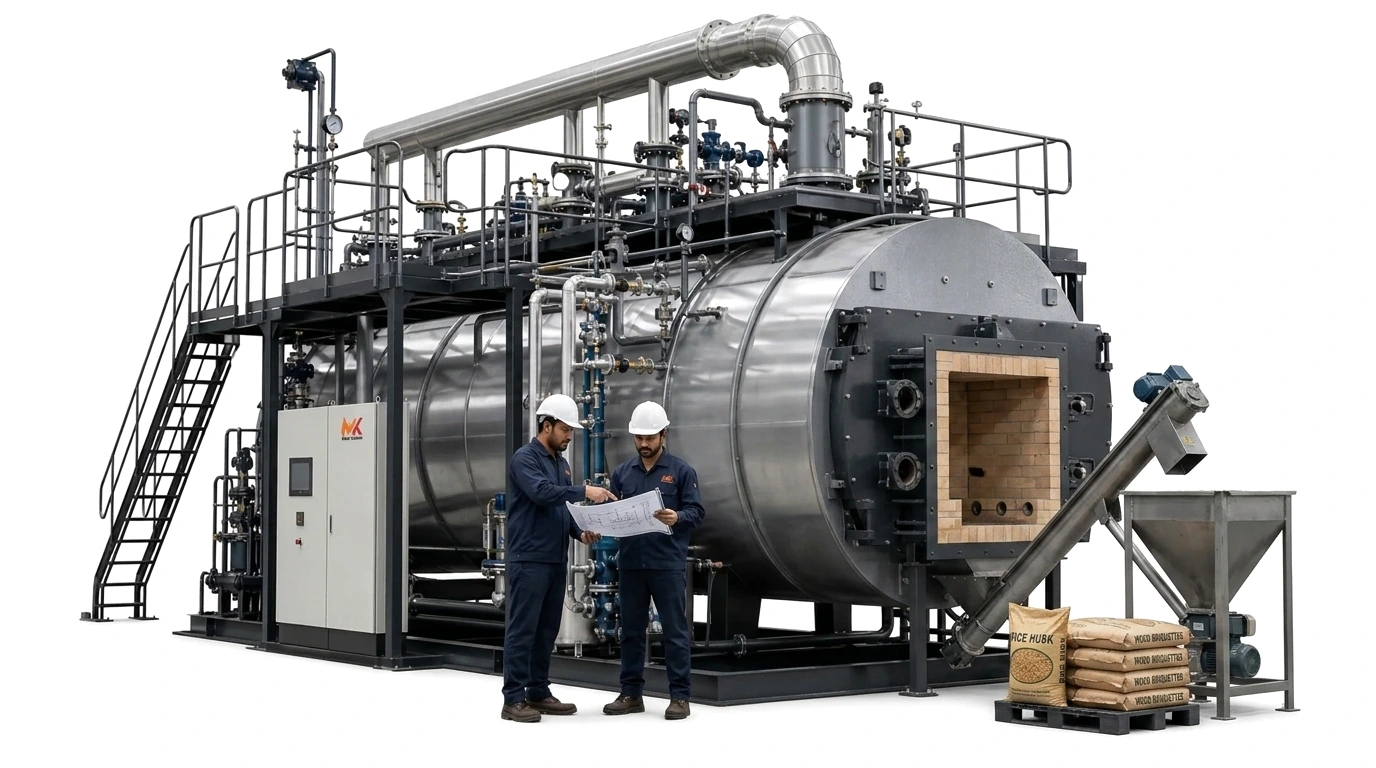
Every winter since the gas curtailment began, factories across Gazipur, Savar, Narayanganj and Ashulia face the same choice during the 6 am to 6 pm industrial load-shedding window: run on Titas Gas at reduced pressure, or fire the standby diesel or furnace oil burner to keep the dyeing floor and finishing lines moving. That standby fuel bill is the real cost of the gas crisis, and for most mills it is large enough to fund a permanent biomass conversion inside a single season.
The diesel and HFO trap
A diesel-fired or HFO-fired boiler is not a cheap fallback - it is roughly three to four times the running cost of piped gas per ton of steam, and the gap has only widened as diesel prices have climbed. Factories that installed dual-fuel burners as an emergency measure during the first curtailment years are now running that "backup" fuel for a large fraction of the production day, every winter, indefinitely. Diesel and HFO backup is not a hedge against an occasional bad day; for a mill in an industrial belt with unreliable gas supply, it has become a structural cost of doing business - one that a solid fuel conversion removes.
There is a second cost that rarely appears on the fuel invoice: production plans built around unpredictable gas pressure. Dyeing batches get rescheduled, shifts get compressed into whatever hours gas pressure holds above 3 PSI, and overtime gets paid to make up lost throughput. None of that shows up as a fuel cost, but it shows up in the P&L.
What a gas-to-biomass conversion requires
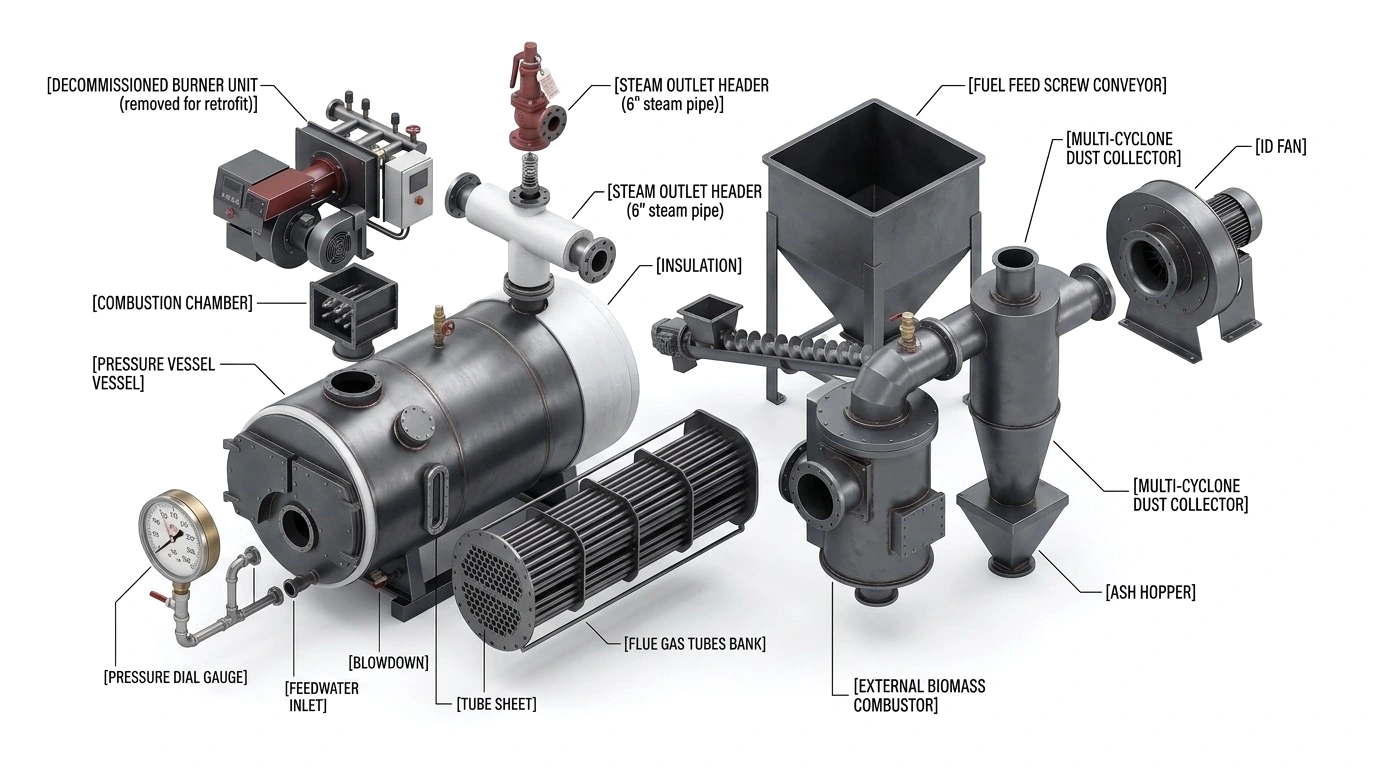
A conversion does not usually mean scrapping the existing pressure vessel. Most fire-tube and water-tube boilers already running on natural gas can keep their shell and tube bank if the last OCIoB hydraulic test shows adequate remaining wall thickness. What gets added is the combustion and fuel-handling train in front of and around that vessel:
| Component | Function | Typical need |
|---|---|---|
| External biomass combustor / gasifier attachment | Burns rice husk, briquette or sawdust and feeds hot gas into the existing furnace | Sized to the boiler's rated steam output, not the fuel volume |
| Fuel feeding system | Hopper, screw conveyor or drag-chain feeder metering fuel into the combustor at a controlled rate | Automated feed rate tied to steam pressure, not manual stoking |
| Grate or fluidised bed | Holds the burning fuel bed and allows ash to fall clear | Travelling grate for husk/briquette; static grate acceptable for smaller units |
| Multi-cyclone dust collector (MCDC) | Strips particulate from flue gas before the stack | Sized against DoE suspended particulate matter (SPM) limits |
| Ash handling | Removes bottom ash and cyclone-collected fly ash | Daily removal capacity matched to fuel ash percentage |
| ID fan upgrade | Overcomes the added pressure drop of the combustor and dust collector | Often the item most underestimated in a budget quote |
| Stack and ductwork modification | Routes flue gas through the new cleanup train | Minor for most retrofits, structural for tall stacks |
The pressure vessel, the safety valve, the water column and the existing OCIoB registration stay in place. What changes is everything upstream of the furnace and everything downstream of the flue gas outlet.
Fuel cost per ton of steam
The number that actually drives the payback calculation is cost per ton of steam delivered, not cost per unit of fuel bought. A worked comparison for a typical three-pass fire-tube boiler at 80-85 per cent thermal efficiency:
| Fuel | Typical NCV | Fuel needed per ton of steam | Indicative fuel cost | Cost per ton steam |
|---|---|---|---|---|
| Natural gas (piped, industrial tariff) | ~9,000 kcal/m³ | ~85 m³ | ~BDT 30/m³ | ~BDT 2,550 |
| Diesel (HSD) | ~10,700 kcal/L | ~74 L | ~BDT 109/L | ~BDT 8,070 |
| Furnace oil (HFO) | ~9,700 kcal/kg | ~84 kg | ~BDT 70/kg | ~BDT 5,880 |
| Rice husk | ~3,200 kcal/kg | ~290 kg | ~BDT 6/kg | ~BDT 1,740 |
| Wood briquette | ~4,000 kcal/kg | ~217 kg | ~BDT 9/kg | ~BDT 1,950 |
Treat the fuel prices as a starting point, not a quote - husk and briquette rates move with the paddy harvest and sawmill supply, and gas and diesel prices move with national policy. What holds steady across every recent price cycle is the ratio: diesel backup runs three to four times the cost of piped gas, and rice husk or briquette runs at roughly two-thirds to three-quarters the cost of piped gas, before counting the hours gas is not available at all.
Run your own boiler's numbers through the calculator below - it uses the same per-ton-of-steam fuel figures as the table above, but lets you swap in your own fuel prices and, if you already have one, your own quoted retrofit capex, rather than a generic figure.
Interactive
Fuel cost and payback calculator
Enter your own boiler's numbers - the fuel cost assumptions come from the table above and can be edited to match your actual invoices.
Your numbers
- Saving per ton steam
- BDT 6,326
- Daily saving once converted
- BDT 1,89,780
- Saving across the season
- BDT 2,27,73,600
Payback period
Add your quoted retrofit capex below to see a payback period.
Illustrative planning estimate from typical NCV and combustion-efficiency figures, not a substitute for a metered site survey.
Common questions
What does a gas to biomass boiler conversion cost in Bangladesh?
Capex depends on boiler size, whether the pressure vessel needs any tube-bank or stack modification, and how much of the fuel-feeding, ash-handling and dust-collection train has to be added - it is sized during a site audit, not from a price list. Most textile and RMG mills recover it inside a single gas-crisis season once diesel or HFO backup hours are counted; use the calculator below with your own quoted capex to see where your plant lands.
How fast does a biomass boiler retrofit pay for itself?
Factories running diesel or HFO backup for 8 to 12 hours a day during winter gas curtailment typically see a 4 to 8 month payback, because the fuel cost gap between diesel and rice husk or wood briquette runs BDT 5,000 to 6,500 per ton of steam.
Can I convert my existing gas boiler to biomass, or do I need a new boiler?
In most cases the existing pressure vessel is retained. The conversion adds an external biomass combustor ahead of the existing furnace, a fuel feeding system, and flue gas cleanup - it does not require replacing the shell, provided the vessel has adequate remaining life on its last OCIoB hydraulic test.
More from the blog
- MaintenanceAn annual boiler maintenance checklist for factory managersPlan daily records, periodic servicing and the annual shutdown with clear responsibilities, inspection evidence and a controlled return to service.
- Maintenance planningBoiler AMC or breakdown calls: compare the full costCompare a boiler annual maintenance contract with on-demand repairs using downtime assumptions, service scope, response commitments and spare-parts exclusions.