
Boiler selection
Thermal oil heater vs steam boiler: choosing for your process
Compare thermal fluid heaters and steam boilers on temperature, pressure, regulation, fire risk and running cost before committing capital in a Bangladesh plant.
This post is also available inবাংলা
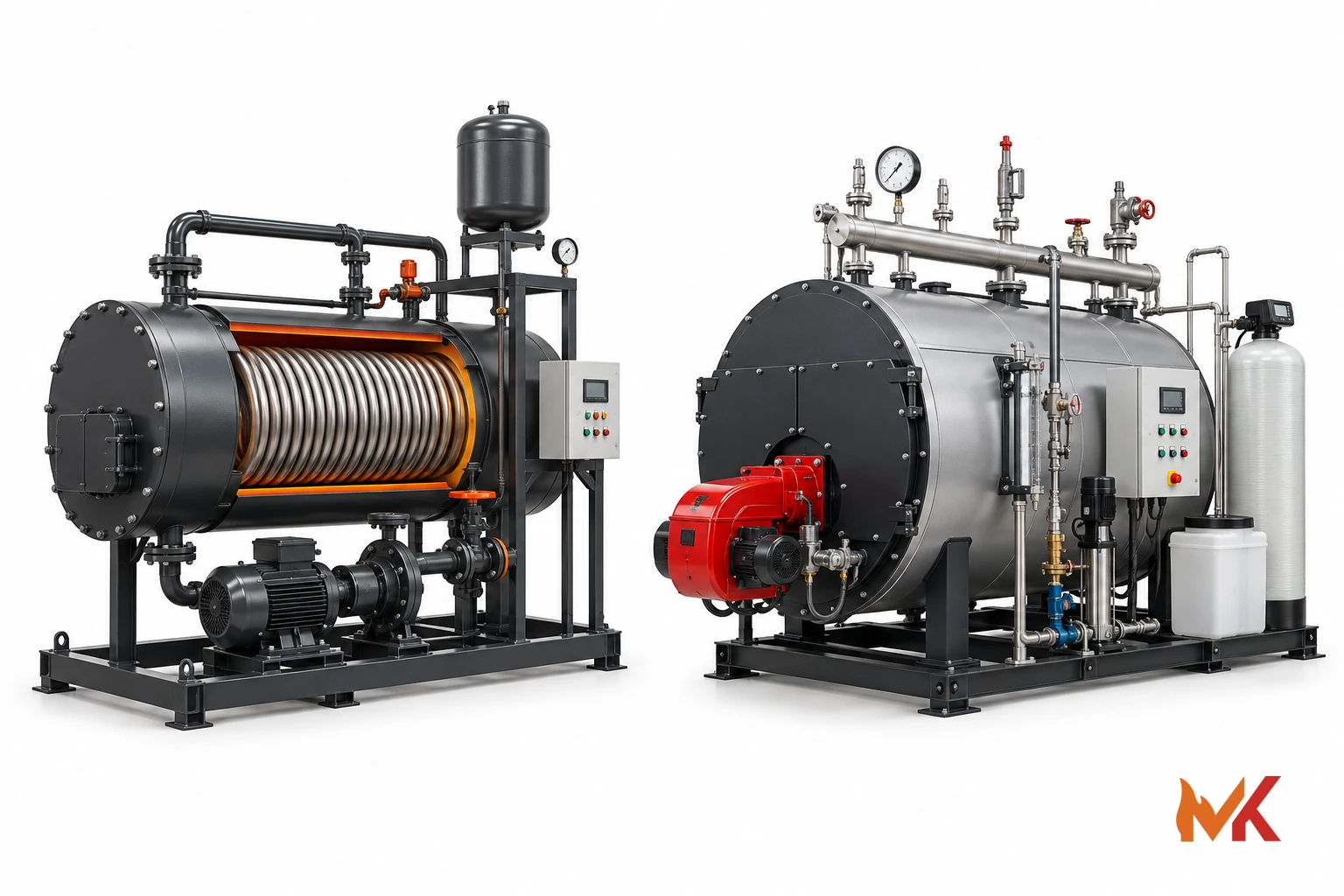
A plywood plant, a laminating line and a dyeing house can all be described as needing "heat", but the equipment that serves them well is not the same. Where the process needs 250 °C or more, providing it with steam means running the system at a pressure most plants would rather avoid. Where the process needs direct steam contact or fast heating of large water volumes, thermal oil cannot do the job at all.
The choice is usually decided by three numbers: the required process temperature, whether steam touches the product, and how much of the year each system sits idle.
The pressure-temperature argument
Saturated steam at 180 °C requires about 10 bar g. At 200 °C it requires 15.5 bar g. At 250 °C it requires almost 40 bar g — a pressure vessel, a feedwater standard and an inspection regime an order of magnitude more demanding than a typical process plant wants.
A thermal fluid heater reaches 250–300 °C at little more than circulation pressure, usually a few bar, because the fluid is not boiling. That single fact drives most of the comparison below.
| Factor | Steam boiler | Thermal oil heater |
|---|---|---|
| Useful temperature range | Up to ~180–200 °C at practical pressures | 150–300 °C, some fluids higher |
| Operating pressure | Pressure rises steeply with temperature | Low; set by circulation, not temperature |
| Heat transfer to process | High, via latent heat; small heat exchangers | Sensible heat only; larger exchangers and higher flow |
| Direct process contact | Possible with culinary or pure steam | Not possible |
| Freeze / corrosion risk | Water treatment, oxygen corrosion, scale | No scale, no corrosion from water chemistry |
| Make-up and losses | Continuous make-up water, blowdown | Small fluid top-up; no blowdown |
| Main failure mode | Tube scaling, corrosion, water level incidents | Fluid degradation and coke deposits on the coil |
| Fire risk | Steam and hot water burns | Hot combustible fluid; leak onto insulation is a real fire hazard |
| Start-up from cold | Faster to first heat for most process duties | Slower; the whole fluid inventory must be raised |
| Statutory regime | Boilers Act registration, periodic OCIoB inspection | Treated differently; confirm the current position for your unit |
Where each one clearly wins
Thermal oil suits laminating and coating lines, plywood and particle board presses, bitumen and asphalt heating, chemical reactors needing precise temperature above 180 °C, and edible oil processing. It also suits plants that shut down for long periods, because there is no water chemistry to maintain during idle time and no freeze or corrosion concern.
Steam suits dyeing and washing, garment finishing and ironing, food cooking and sterilisation, humidification, and anywhere the process needs direct steam injection. It also suits plants with many varied users across a wide site, because a steam header distributes energy compactly and each user takes what it needs through its own trap station.
The mixed case is common in Bangladeshi textile complexes: a steam boiler for the dye house and a thermal oil heater for the stenter or coating line, both fired on the same fuel.
Running cost is not decided by the technology
Both systems burn the same fuels — natural gas, diesel, HFO, rice husk or briquettes. Neither is inherently cheaper to run. The difference in real operating cost comes from four places:
- Distribution losses. Steam loses energy through failed traps, flash from an unrecovered condensate line and leaks. Thermal oil has no traps and no flashing, so a poorly maintained steam plant will lose far more than a poorly maintained oil circuit. A well-maintained steam plant with condensate recovery closes most of that gap.
- Blowdown and water treatment. A steam boiler carries a continuous blowdown loss and a chemical bill; a thermal oil system carries neither, but does carry periodic fluid replacement.
- Standing losses. A thermal oil system holds a large hot fluid inventory and typically keeps it circulating. A plant running one shift a day may find that inventory expensive to hold overnight.
- Pumping power. Thermal oil transfers sensible heat only, so circulation rates and pump power are substantially higher than boiler feedwater pumping.
Compare total annual energy including electricity, make-up, chemicals and fluid replacement over an operating year that reflects your real shift pattern, not a nameplate hour.
The risks that decide the site layout
Fluid heaters have their own safety standard: NFPA 87 covers construction, controls and safeguards, and the US Department of Energy’s process heating resources cover the efficiency side.
The dominant thermal oil hazard is fluid leaking onto hot surfaces or into insulation, where it can auto-ignite well below the temperature people expect. Specify welded pipework in preference to flanges where practical, use metal-jacketed insulation with leak detection at flanges and valves, and keep the expansion tank cool and nitrogen-blanketed where the fluid specification calls for it. Plan the fire response and drainage before commissioning, not after.
Fluid condition is the maintenance programme. Sample and test at least annually for viscosity, flash point, acid number and carbon residue. Rising carbon residue means film temperature is too high somewhere, usually from low flow or a fouled coil, and a coked coil is an expensive repair and a rupture risk.
On the steam side, the corresponding discipline is water treatment, TDS control and safety interlock testing — covered in our explosion prevention protocols and feedwater treatment articles.
Specify before you compare quotations
Write down the required process temperature at the point of use, the heat load in kW including start-up, the acceptable temperature tolerance, the operating hours per week, and whether the medium can contact the product. Those five lines make competing quotations comparable and stop the decision being made on headline equipment price.
Ask each supplier for the same things: guaranteed thermal efficiency at your fuel and stated basis, circulation pump power, expected fluid or water consumption, required maintenance interval and what the statutory regime for that unit is in Bangladesh. If one supplier answers the regulatory question with "it needs no approval", ask them to put it in writing.
For a steam-side comparison, see fire-tube vs water-tube selection and how to size a steam boiler. To scope a thermal fluid or steam installation against your actual process load, contact our engineering desk or review our installation and commissioning service.
Related reading: Gas to biomass boiler conversion cost in Bangladesh - Capex, payback and ROI and Surviving low gas pressure (1-3 PSI) in Gazipur, Savar and Narayanganj.
Common questions
Is a thermal oil heater exempt from boiler regulation in Bangladesh?
Thermal fluid heaters operate at low pressure and are treated differently from steam boilers under the Boilers Act, but they are not unregulated equipment. Confirm the current position for your specific unit with the Office of the Chief Inspector of Boilers before assuming any exemption, and note that fire safety and DoE emission obligations apply regardless.
Can one plant run both?
Yes, and many do. A common arrangement is thermal oil for high-temperature processes such as laminating or stenter heating, with a steam boiler for dyeing, washing and humidification.
How long does thermal fluid last?
It depends on film temperature, oxygen ingress and how the system is operated. Sample and test the fluid periodically; degraded fluid causes coking on the heater coil, which is the main failure mode of these systems.
More from the blog
- Boiler selectionFire-tube vs water-tube boilers for textile dyeingCompare boiler construction, load response, maintenance access and purchase specifications before selecting steam equipment for a Bangladesh textile mill.
- Steam efficiencyCondensate recovery: what it saves and what it costs to installWork out how much condensate your plant is dumping, what returning it is worth in fuel, water and chemicals, and which pump and pipework arrangement suits a dyeing floor.