
Sizing and specification
How to size a steam boiler for a textile dyeing factory
Nameplate figures do not size a boiler. Measure peak against average steam demand in kg/hr, fix the working pressure and count the condensate you get back, then pick the capacity from those three numbers.
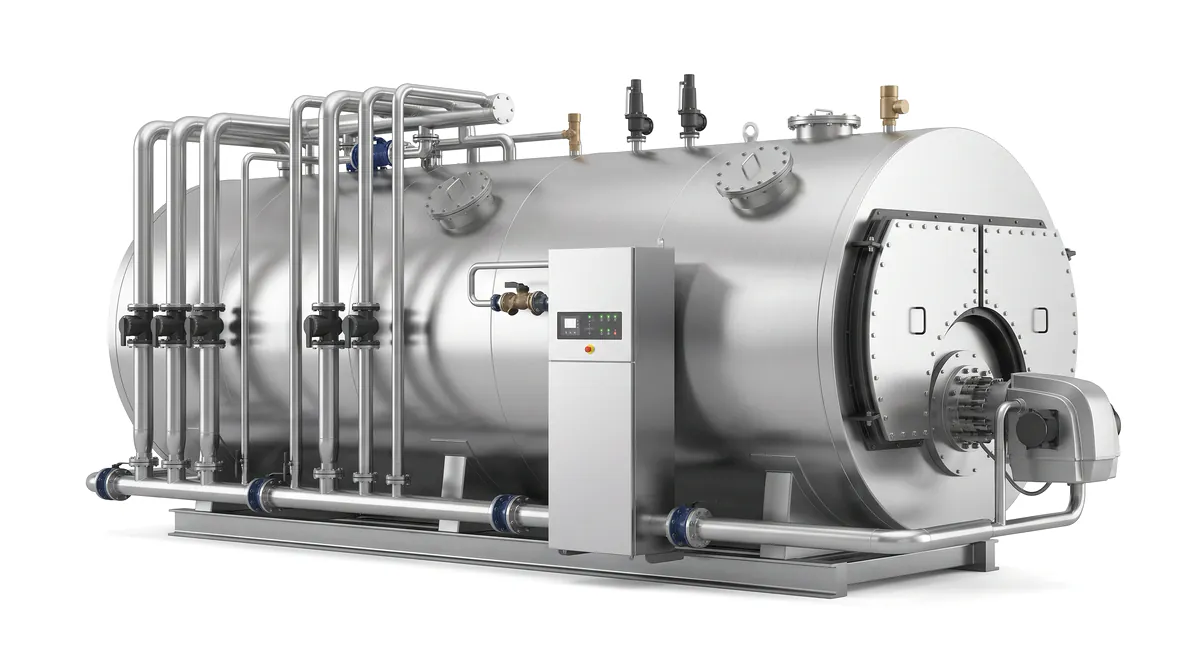
Most sizing mistakes on a Bangladeshi dyeing floor happen before anyone opens a catalogue. The factory adds up the nameplate consumption of every machine, adds a margin, and orders the next size up. The result is a boiler that spends its life cycling on and off at 40 per cent load, burning more gas per kilogram of steam than the same plant would at 80 per cent.
Sizing is a measurement job. Three numbers decide the capacity, and all three come off the floor rather than out of a brochure.
1. Peak demand, not total connected load
Dyeing is a batch process. A jet dyeing machine draws hard during fill and heat-up, then almost nothing while it holds temperature. Whether your machines peak together decides everything.
Walk the floor with the production plan and mark, for one full shift:
- how many machines fill at the same time
- how long each fill and heat-up lasts
- what else runs through the same header - stenter, calender, drying cylinders, the finishing line
Two factories with identical machine lists can need boilers 40 per cent apart purely because one staggers its fills and the other does not.
Reading demand from the fuel meter
Where there is an existing boiler, the fuel meter answers the question without any modelling. Log gas consumption at ten-minute intervals for two working days, convert to steam output, and the peak is visible in the trace. As a rough conversion for a modern three-pass fire tube boiler on natural gas:
| Fuel | Typical steam output |
|---|---|
| 1 m³ natural gas | 12 to 14 kg steam |
| 1 litre diesel or HSD | 12 to 13 kg steam |
| 1 kg biomass briquette | 3.5 to 4.5 kg steam |
The spread inside each row is efficiency and feedwater temperature. Measure your own plant before trusting the middle of the range.
2. Working pressure at the machine
Set the generation pressure from the highest machine requirement plus distribution loss, not from the largest number anyone remembers. Most dyeing and finishing equipment in Bangladesh works between 6 and 10 bar. Generating 1 to 2 bar above the highest demand covers pipe losses across a long factory, and local reducing stations bring each machine down to what it actually needs.
Generating higher than necessary costs money every hour: higher stack temperature, more flash loss at every trap, and a lower latent heat fraction in each kilogram of steam.
3. Condensate return
Condensate that comes back is water you do not soften, deaerate or heat from ambient. Every 6 °C rise in feedwater temperature is roughly one per cent of fuel. A plant returning 70 per cent of its condensate at 85 °C needs a noticeably smaller boiler than the same plant dumping it to drain.
Before adding capacity, check the return line. Failed traps, an undersized condensate pump or a flash vessel venting to atmosphere all show up as "we need a bigger boiler" when the real fault is downstream.
Putting the three numbers together
A worked example from a knit dyeing and finishing unit near Gazipur:
- Measured peak: 4,200 kg/hr for roughly 25 minutes per cycle
- Measured average across the shift: 2,400 kg/hr
- Working pressure: 8 bar at the machine, generate at 10 bar
- Condensate return: 62 per cent at 88 °C
Sizing on the peak alone points at a 4.5 t/hr boiler that would run at just over half load most of the day. The better specification is a 3 t/hr boiler with a steam accumulator sized for the fill surge. The accumulator absorbs the peak, the boiler runs near its best efficiency band, and the capital cost lands lower than the oversized alternative.
That trade only works if the peak is genuinely short and repeatable, which is exactly what the shift log tells you.
Where oversizing actually hurts
- Cycling losses. Every purge cycle throws the furnace volume of heated air up the stack. A boiler that cycles four times an hour loses far more than one modulating steadily.
- Wet steam at low fire. Large water surface, low steam draw, and carryover starts showing up as water in the header and spotted fabric.
- Turndown limits. A burner with 4:1 turndown on an oversized boiler cannot follow a light night shift, so it cycles instead of modulating.
What to hand your supplier
A quotation request that produces comparable offers contains:
- Peak and average steam demand in kg/hr, with the measurement period
- Working pressure at the machine and the required generation pressure
- Fuel and its supply pressure, plus any dual-fuel requirement
- Condensate return percentage and temperature
- Feedwater analysis - hardness, TDS, chlorides, silica
- Available floor area, door width and stack route
- Whether the boiler must carry a Bangladeshi boiler registration from day one
With those seven lines, any competent supplier gives you a capacity, a burner selection and a water treatment scope that can be compared like for like. Without them, you are comparing guesses.
If you want the measurements taken for you, our engineers run a steam survey on site and hand back the demand trace, the sizing calculation and a specification you can tender.
Common questions
What size boiler does a textile dyeing factory need?
It depends on peak demand, not on machine count. A dyeing floor running six jet dyeing machines with simultaneous fills typically peaks between 3,000 and 6,000 kg/hr while averaging 1,800 to 3,000 kg/hr. Size the boiler on measured peak demand with a steam accumulator, or you buy capacity that idles all day.
What working pressure should a dyeing boiler run at?
Most dyeing and finishing lines in Bangladesh work between 6 and 10 bar at the machine. Generate 1 to 2 bar above the highest machine requirement to cover distribution losses, then reduce locally at each machine.
How much condensate should come back?
A well-piped dyeing plant returns 55 to 75 per cent of its condensate. Below 40 per cent, the problem is usually failed steam traps or a vented flash vessel, and fixing that is cheaper than adding boiler capacity.
More notes
- Water treatmentWhy Bangladeshi groundwater destroys boiler tubesGroundwater across the delta carries high calcium and magnesium hardness plus dissolved oxygen. Untreated, it scales tubes within months, drives fuel consumption up and eventually splits the metal. Here is the treatment that prevents it.
- Compliance and inspectionBoiler inspection and certification in Bangladesh, step by stepEvery steam boiler in Bangladesh needs an annual certificate from the Office of the Chief Inspector of Boilers. Here is what the inspection covers, how to prepare the plant and what stops a certificate being issued.