
Steam efficiency
Condensate recovery: what it saves and what it costs to install
Work out how much condensate your plant is dumping, what returning it is worth in fuel, water and chemicals, and which pump and pipework arrangement suits a dyeing floor.
This post is also available inবাংলা
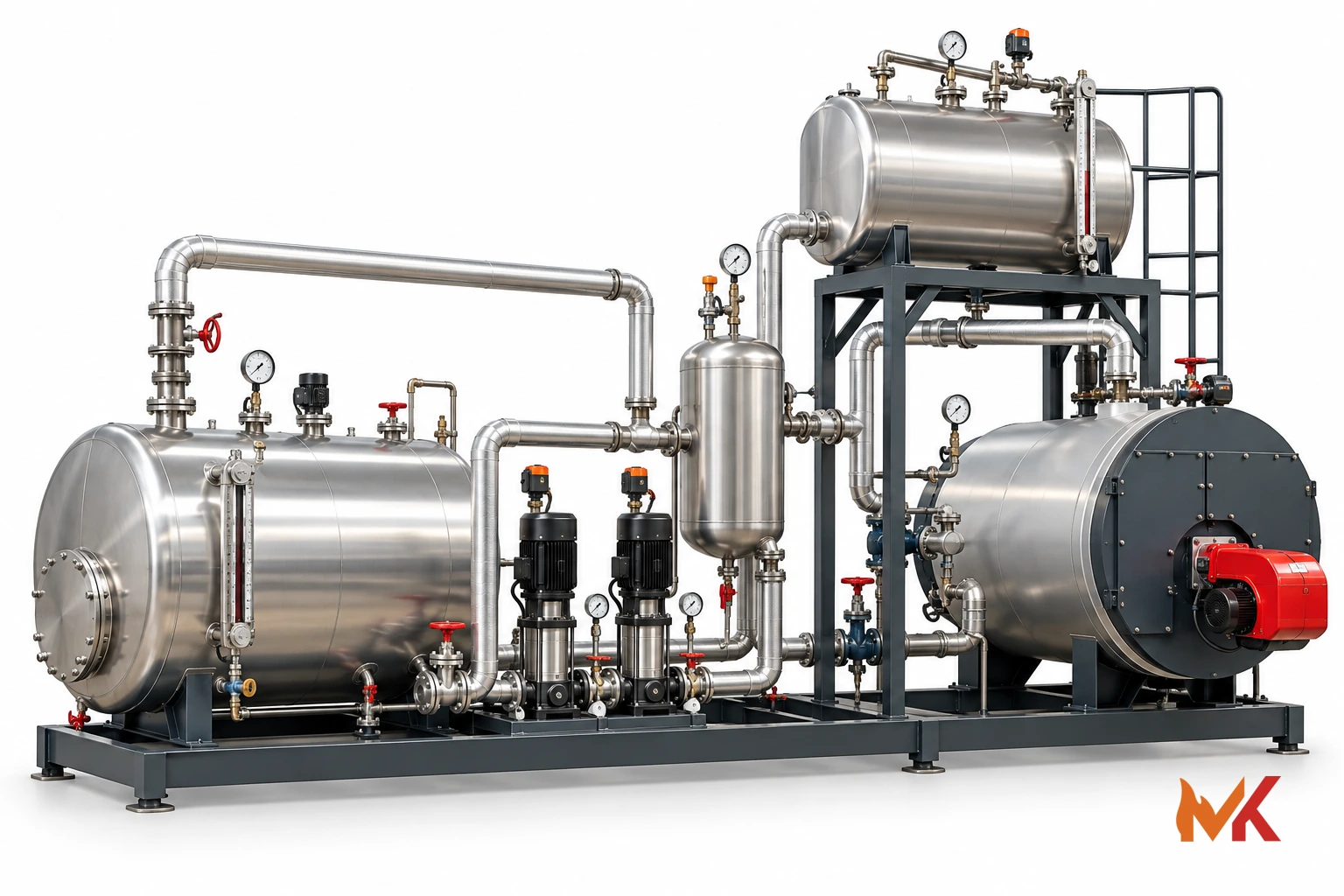
Walk the back of most dyeing floors in Savar or Narayanganj and you will find condensate running to drain — hot, chemically treated water that the boiler paid to produce, going into the effluent plant that then pays to handle it. Every kilogram dumped has to be replaced by cold, hard borehole water, softened, dosed and heated again from roughly 30 °C.
Condensate recovery is one of the few steam projects where the savings appear in three separate budget lines at once: fuel, water treatment and effluent. That makes it easy to justify and easy to overstate, so the arithmetic below keeps the three separate.
What a kilogram of returned condensate is worth
Condensate returning at 90 °C carries about 377 kJ/kg. Make-up water at 30 °C carries about 126 kJ/kg. The heat saved is roughly 251 kJ for every kilogram returned — and that is only the first of three savings.
Take an illustrative plant generating 6 t/h of steam, 6,000 hours a year, currently returning 25% of its condensate and aiming for 65%:
| Item | Value |
|---|---|
| Additional condensate returned | 40% of 6,000 kg/h = 2,400 kg/h |
| Heat saved per kg (90 °C vs 30 °C) | ~251 kJ |
| Annual heat saved | 2,400 × 6,000 × 251 = 3,614,400,000 kJ |
| Fuel energy at 85% boiler efficiency | ~4,252,000 MJ |
| At an illustrative 1.10 BDT/MJ | ~4.68 million BDT/year |
| Treated make-up water avoided | 14,400 m³/year |
| Blowdown reduction from lower feedwater TDS | Calculated separately; see below |
Substitute your own marginal fuel cost and water cost — the point of the table is the structure, not the total. The water line alone is significant where a plant buys treated water or pays for effluent volume.
The third saving is indirect. Returning clean condensate lowers feedwater TDS, which lowers the required blowdown rate, which saves fuel again. On the numbers in our blowdown article, lifting return from 20% to 50% cut required blowdown from 9.4% to 5.4%. Do not double-count it: calculate the blowdown saving from the new feedwater TDS, not by adding a separate percentage.
Find out what you are actually returning
Spirax Sarco’s introduction to condensate recovery and its reference on flash steam explain the two-phase behaviour that governs how the return main must be sized.
Most plants over-estimate their return rate. Measure it rather than assume it:
- Meter the make-up water into the feed tank for a full week of normal production. Make-up divided by steam generated gives your true loss rate.
- Check the feed tank temperature. A tank sitting at 45 °C is not receiving much condensate, whatever the drawing says. A well-returned system usually runs 75–90 °C.
- Walk every drain point with a torch. Open drains discharging continuously are either dumped condensate or failed-open traps, and both belong on the same survey.
- List the users excluded from return and why. "It was contaminated once in 2023" is not a current engineering reason.
Building the return system
| Component | Purpose | Selection point that matters |
|---|---|---|
| Receiver / collection vessel | Breaks the line pressure, allows flash steam to separate | Vent sized so flash steam does not pressurise the vessel; sited low enough for gravity fall from users |
| Return pump | Lifts condensate to the feed tank | Near-saturation condensate cavitates electric pumps; a pressure-powered pump avoids this and needs no motor in a wet area |
| Flash vessel | Recovers usable low-pressure steam from high-pressure condensate | Only worth it where there is a genuine low-pressure user or a feed tank that can absorb the flash |
| Return main | Carries condensate and flash back | Sized for two-phase flow, not water flow; undersized mains cause backpressure that stalls traps |
| Conductivity monitor and dump valve | Protects the boiler from a contaminated return | Set point and automatic dump, so one leaking coil dumps its own condensate instead of the whole system |
| Feed tank | Mixes return with make-up and deaerates | Must accept the higher temperature without cavitating the feedwater pumps |
The most common installation mistake in retrofits is treating the return main as a water pipe. Condensate at pressure flashes as it enters the line; the resulting mixed flow needs far more cross-sectional area than the liquid alone. An undersized main raises backpressure on every trap discharging into it, which stalls drainage on the dyeing machines the project was meant to help.
Building the payback case
Assume the installed cost of the receiver, pumps, 180 m of return main, insulation, monitoring and commissioning for the illustrative plant above comes to 2.2 million BDT. Against a fuel saving of 4.68 million BDT a year, simple payback is roughly six months. Halve the assumed recovery rate and it is about a year.
Present both cases. The recovery rate achieved depends on how many user points can actually be tied in, and the honest version of the business case shows what happens if only part of the plan is delivered. Add the water and effluent saving as separate lines so finance can see which parts of the benefit are certain and which depend on tariff assumptions.
Phase the work by return line, not by budget year. Each completed line delivers its own saving, and the feed tank temperature is a live measurement of progress that anyone can read.
Before you start
Fix failed traps first. Returning condensate through a leaking trap population sends live steam into the return main, pressurising it and stalling every other trap on the line. Survey the traps, repair them, then commission the return system into a network that behaves the way it was sized to behave.
Check that the boiler feed pumps can handle a hotter feed tank. Raising feed temperature from 45 °C to 85 °C changes the net positive suction head available, and a pump that cavitates on hot water will make the project look like a failure for reasons unrelated to the recovery scheme.
Read this with the steam trap audit method and the efficiency calculation methods so the savings land in one consistent energy balance. To survey your return rate and scope a recovery system, contact our engineering desk or see our repair and maintenance service.
Related reading: Achieving LEED certification in Bangladesh via steam and boiler upgrades and Why Bangladeshi groundwater destroys boiler tubes.
Common questions
Why do factories dump condensate when it is obviously valuable?
Usually because the return line was never built, or because one contaminated user point poisoned the whole return and the plant responded by dumping everything. The fix is to isolate and monitor that point, not to abandon recovery.
Can we return condensate from a dyeing machine heat exchanger?
Normally yes, since it is indirect heating. Contamination risk comes from leaking coils, so fit a conductivity monitor with an automatic dump valve on suspect returns rather than excluding them by default.
Is an electric pump or a pressure-powered pump better?
It depends on the return conditions. Pressure-powered pumps handle near-saturation condensate without cavitation and need no electrical supply in wet areas; electric pumps suit cooler, higher-flow returns. Size on the actual temperature at the receiver.
More from the blog
- Steam efficiencyThe cost of failed steam traps in a Bangladesh factoryCalculate steam-trap losses in BDT, distinguish leaks from drainage faults, and build a repair list that your maintenance and finance teams can verify.
- Boiler selectionThermal oil heater vs steam boiler: choosing for your processCompare thermal fluid heaters and steam boilers on temperature, pressure, regulation, fire risk and running cost before committing capital in a Bangladesh plant.