
Water treatment
Boiler blowdown: TDS control and heat recovery that pays
Set a defensible blowdown rate from measured TDS, cost the water and fuel it wastes in BDT, and decide whether automatic control or flash recovery is worth installing.
This post is also available inবাংলা
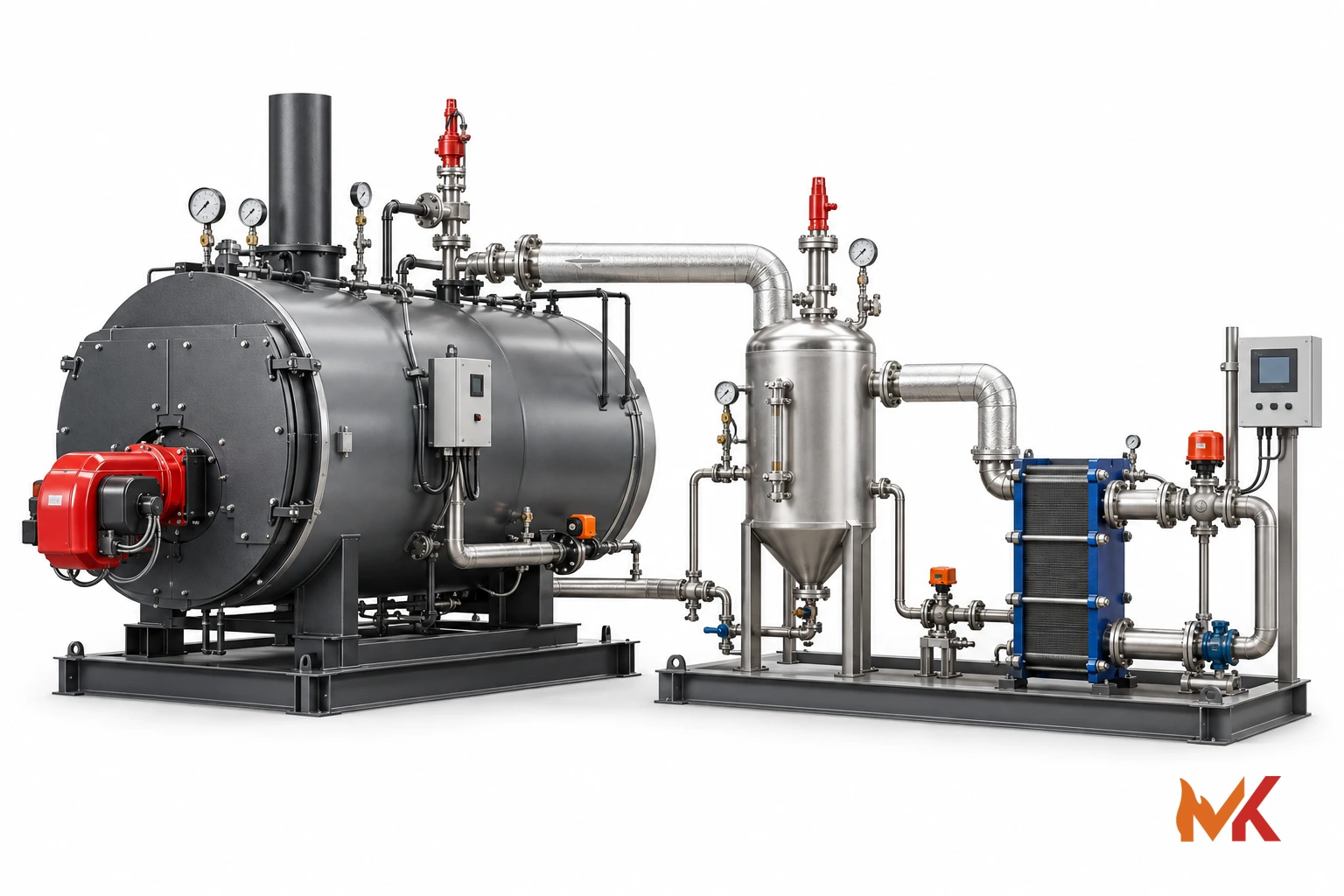
Blowdown is the one loss a boiler house deliberately creates. Every kilogram blown down leaves at saturation temperature, carrying the fuel used to heat it, the treated make-up water it displaces and the chemicals dosed into it. In Gazipur, Savar and Narayanganj, where borehole water is hard and condensate return is often low, blowdown rates of 8–12% are common on plants that have never measured them.
The engineering question is not how to blow down less. It is what TDS limit your boiler actually has, what feedwater quality you are feeding it, and what the arithmetic between those two numbers requires.
The blowdown rate is a calculation, not a habit
Blowdown (% of feedwater) = feedwater TDS ÷ (maximum permitted boiler water TDS − feedwater TDS) × 100
Take an illustrative 5 t/h shell boiler at 10 bar g. The manufacturer's stated maximum boiler water TDS is 3,500 ppm. Condensate return is poor, so feedwater TDS after softening measures 300 ppm.
Blowdown = 300 ÷ (3,500 − 300) × 100 = 9.4% of feedwater, roughly 470 kg/h.
Now raise condensate return from 20% to 50%, which drops feedwater TDS to about 180 ppm:
Blowdown = 180 ÷ (3,500 − 180) × 100 = 5.4%, roughly 270 kg/h.
The same boiler, the same limit, 200 kg/h less hot water down the drain — achieved entirely on the feedwater side. This is why a blowdown problem is usually a condensate and make-up problem wearing a different name.
| Feedwater TDS (ppm) | Boiler limit (ppm) | Required blowdown | On a 5 t/h boiler |
|---|---|---|---|
| 400 | 3,500 | 12.9% | ~645 kg/h |
| 300 | 3,500 | 9.4% | ~470 kg/h |
| 180 | 3,500 | 5.4% | ~270 kg/h |
| 100 | 3,500 | 2.9% | ~145 kg/h |
Spirax Sarco’s reference on water treatment, storage and blowdown for steam boilers sets out how these limits are derived, and the US Department of Energy’s steam system resources cover blowdown control and heat recovery as separate measures.
Use the boiler maker's limit, and the limits your water treatment specialist sets for alkalinity, silica and suspended solids alongside TDS. The tightest of those governs. A boiler held to 3,500 ppm TDS can still foam if alkalinity or silica is out of range.
What the wasted heat is worth
Blowdown water leaves at saturation temperature — about 184 °C at 10 bar g, an enthalpy near 781 kJ/kg against make-up water at perhaps 30 °C (126 kJ/kg). The recoverable difference is roughly 655 kJ per kilogram.
At 470 kg/h and 6,000 operating hours a year:
470 × 6,000 × 655 = 1,847,100,000 kJ per year.
At an assumed boiler efficiency of 85%, the fuel energy behind that is about 2,173,000 MJ. Apply your own marginal fuel cost per MJ to get the BDT figure; at an illustrative 1.10 BDT/MJ that is roughly 2.39 million BDT a year in heat alone, before counting the treated water, the softener salt and the dosing chemicals that go with it.
These are planning assumptions with your own fuel price to be substituted, not a quoted saving. But they set the scale: on most mid-sized plants the blowdown line is worth more than the steam trap list.
Three levels of intervention
| Level | What is installed | What it addresses | Typical constraint |
|---|---|---|---|
| Manual discipline | Scheduled bottom blowdown, shift TDS testing, logged results | Over-blowing and under-blowing from guesswork | Depends entirely on operator consistency |
| Automatic TDS control | Conductivity probe in the boiler shell, modulating or on/off surface blowdown valve, controller | Holds TDS just under the limit instead of well under it | Probe fouling; needs periodic calibration against a lab sample |
| Heat recovery | Flash vessel returning flash steam to the deaerator, plus a heat exchanger preheating make-up water from the residual blowdown | Recovers the enthalpy that discipline alone cannot | Requires tie-ins during a shutdown; needs a deaerator or feed tank that can accept flash steam |
Automatic TDS control is usually the first step with a defensible payback, because it both cuts the blown volume and removes the risk of running over the limit between manual tests. Flash recovery makes most sense where blowdown rates stay above roughly 5% after the feedwater side has been improved, and where a feed tank is close enough for a short return line.
Getting the measurement right
Sample blowdown for TDS from a properly cooled sample point, not from the hot line. Hot samples flash, concentrate and read high. Conductivity readings must be temperature-compensated and converted to TDS using a factor appropriate to your boiler water chemistry — a single generic factor applied to every plant is a common source of error.
Check the probe against a laboratory sample at least monthly. A fouled conductivity probe reads low, the controller stops blowing down, and the first symptom is wet steam and water hammer on the distribution header rather than an alarm.
Keep bottom blowdown separate in the log. It is a short, sharp removal of sludge from the lowest point, usually once or twice a shift, and it should never be lengthened to compensate for TDS drift. Doing so wastes far more heat than the equivalent surface blowdown and disturbs the water level.
Where blowdown fits in the wider plan
Sequence the work in the order that removes cost rather than adds equipment: fix condensate return first, then feedwater treatment, then automatic TDS control, then heat recovery. Installing a flash recovery system on a plant that returns 20% of its condensate is recovering heat from a problem that should have been shrunk first.
Record the blowdown rate on every efficiency test. It is one of the most common reasons a direct efficiency calculation reads higher than the indirect one, and an unmetered blowdown line quietly credits its own losses to the steam output.
Read this alongside feedwater treatment and scale control and the direct and indirect efficiency methods. For boiler water testing, TDS control or a blowdown recovery scope, contact our engineering desk or review our boiler water treatment service.
Related reading: Condensate recovery: what it saves and what it costs to install and Achieving LEED certification in Bangladesh via steam and boiler upgrades.
Common questions
How often should we do bottom blowdown?
Bottom blowdown removes settled sludge and is done in short bursts on a schedule set by your water conditions, typically once or twice per shift. It is not the way to control TDS; that is the job of continuous surface blowdown.
Can we just stop blowing down to save fuel?
No. Uncontrolled TDS causes foaming, carryover and wet steam reaching process equipment, and can lead to deposits and tube damage. Reduce the required blowdown by improving feedwater and condensate return, not by ignoring the limit.
Does blowdown heat recovery need a shutdown to install?
The tie-ins usually do. Flash vessel and heat exchanger work is normally scheduled into a planned outage or an annual inspection window rather than done live.
More from the blog
- Water treatmentWhy Bangladeshi groundwater destroys boiler tubesGroundwater across the delta carries high calcium and magnesium hardness plus dissolved oxygen. Untreated, it scales tubes within months, drives fuel consumption up and eventually splits the metal. Here is the treatment that prevents it.
- Boiler selectionThermal oil heater vs steam boiler: choosing for your processCompare thermal fluid heaters and steam boilers on temperature, pressure, regulation, fire risk and running cost before committing capital in a Bangladesh plant.