
Boiler selection
Fire-tube vs water-tube boilers for textile dyeing
Compare boiler construction, load response, maintenance access and purchase specifications before selecting steam equipment for a Bangladesh textile mill.
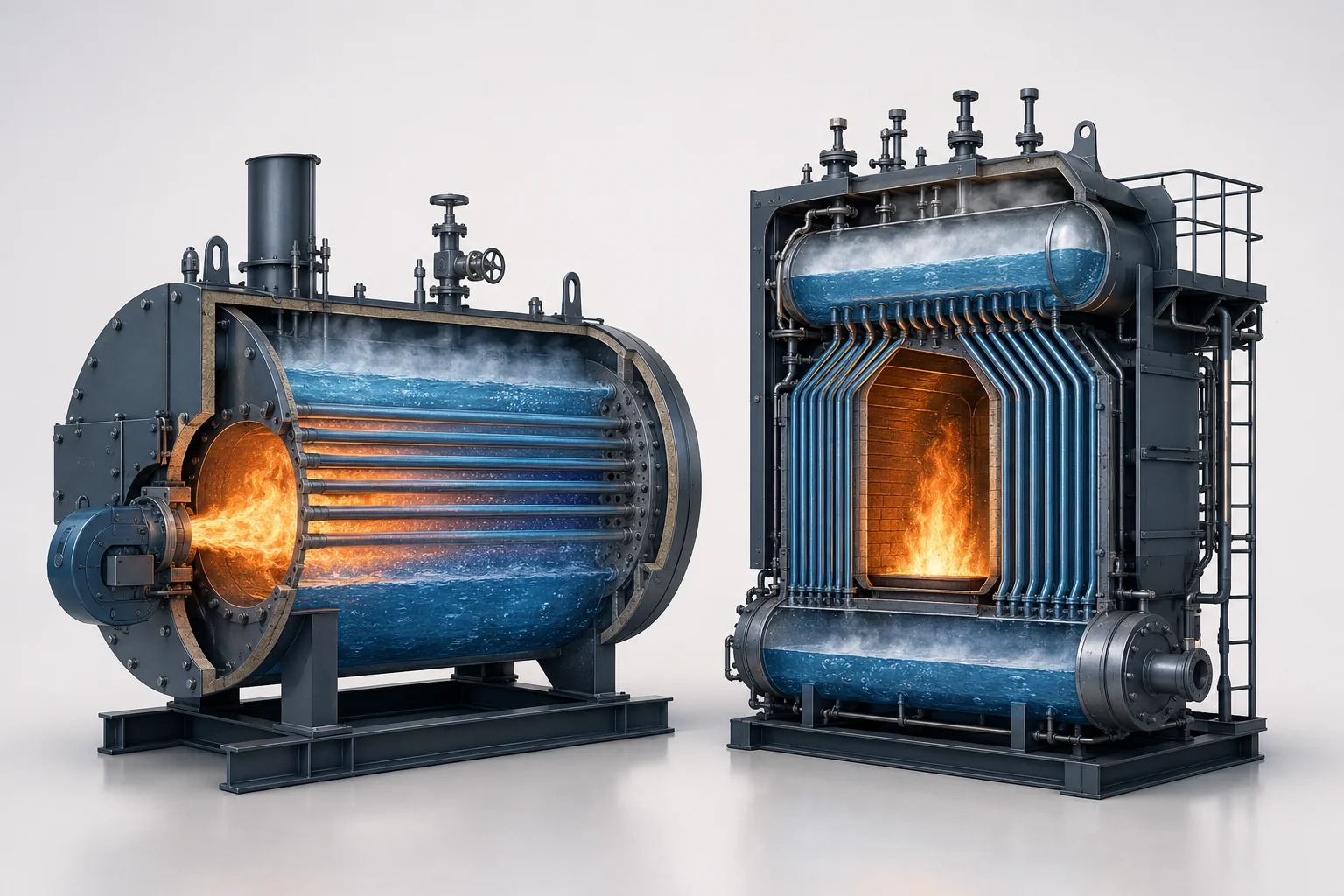
Two boilers with the same tonnes-per-hour rating can behave differently on a dyeing floor. One may spend the night cycling at low load; another may struggle when several machines begin heating together. For a mill in Gazipur or Savar, choosing fire-tube versus water-tube equipment starts with the steam-demand profile and the complete installation.
The construction label is useful, but it cannot replace a duty specification. Ask what each offered model can deliver at your required pressure, fuel quality and feedwater temperature, and how it performs through the rest of the shift.
Understand the physical difference
In a fire-tube, or shell, boiler, combustion gases pass through tubes surrounded by water. In a water-tube boiler, water flows inside tubes heated externally by combustion gases. Water-tube arrangements can serve higher pressure and larger output duties, while packaged shell boilers are common in industrial process service. Spirax Sarco explains these principles in its guides to shell boilers and water-tube boilers.
The cover image is a conceptual illustration of these arrangements, not a construction or piping drawing. Actual circulation paths, access points and protective equipment depend on the selected design.
Compare the installation you would actually buy
| Decision area | Fire-tube offer: questions to ask | Water-tube offer: questions to ask |
|---|---|---|
| Required duty | Does the selected shell design cover output and pressure? | Is the arrangement proportionate to the required duty? |
| Load changes | What pressure variation is expected during a batch surge? | What response is guaranteed by the boiler and controls together? |
| Low-load running | What is the stable minimum output before cycling? | What operating constraints apply at minimum load? |
| Space | Is there room to open doors and withdraw tubes? | Is there access to drums, tube banks and elevated components? |
| Water treatment | What feedwater and boiler-water limits are specified? | What treatment and monitoring does this design require? |
| Maintenance | Can local teams obtain matched tubes, gaskets and burner parts? | What specialist tube work and inspection access are needed? |
| Delivery | What arrives assembled, and what remains site work? | Which sections need erection, welding or specialist commissioning? |
Avoid fixed claims that one design always occupies less space or starts faster. Compare vendor drawings and stated operating procedures for the actual models, including ancillary equipment and maintenance clearances.
Measure the dyeing load before requesting prices
Record steam flow, header pressure and machine operating states over representative shifts. Include a heavy production day, a lighter shift and the start-up period. Note when batch heating starts and when steam demand falls away.
As an illustrative requirement, a mill might average 2.5 t/h but demand 4.5 t/h for fifteen minutes when several machines heat together. If a proposed boiler supplies 3.0 t/h during that interval, the simplified shortfall is:
(4.5 − 3.0) × 0.25 = 0.375 tonnes of steam.
This is a demand-balance calculation, not an accumulator size or proof that a 3.0 t/h boiler is suitable. Storage design would require usable pressure range, flash fraction, vessel volume and recharge time. Repeated peaks with too little recovery time can invalidate the idea entirely.
Start with our textile boiler sizing guide, then have the final capacity and any storage proposal checked against measured data. Also investigate distribution restrictions before treating every pressure dip as a boiler-capacity shortage.
Make efficiency offers comparable
Request fuel-to-steam performance at several expected load points. Each offer should state the calorific-value basis, fuel specification, feedwater temperature, steam pressure and treatment of auxiliary electricity. An efficiency figure based on NCV cannot be compared directly with one based on GCV.
Ask whether an economizer is included and whether the stated performance depends on it. For biomass, specify moisture, ash and usable fuel-size range. For gas, provide the available supply conditions; a burner performance promise is not useful if the site cannot provide the specified fuel supply.
A large peak rating can hide poor low-load behaviour. Request the minimum stable output of the complete system, not just a burner turndown ratio. Then compare that minimum against your night-shift demand and standby strategy.
Price what the boiler house needs
Include the treatment plant, feed tank or deaerator, pumps, stack, electrical work, foundations, delivery, installation and commissioning. Add fuel storage and handling, ash removal and emission controls where the selected fuel requires them.
For either design, identify the route from the unloading point to the foundation. A packaged unit may fit the planned footprint but not the access door. Maintenance clearance must remain usable after cable trays, platforms and pipework are installed.
Ask the supplier to separate factory scope from site scope. Include acceptance criteria for output, pressure stability, fuel consumption where guaranteed, and protective-function testing. Record the documents and training that must be delivered before handover.
Choose from the operating case
A packaged fire-tube proposal can be a practical candidate for a moderate process duty with serviceable local support. A water-tube proposal may be appropriate where pressure, output or the specified furnace arrangement calls for it. Neither description settles the purchase without checking the actual model.
Also compare one larger unit with multiple units where continuity matters. Additional equipment may improve flexibility, but it adds capital cost, controls and maintenance. Decide how much steam the plant must retain during a planned or unplanned outage before paying for redundancy.
Send the same load profile and scope sheet to every bidder. If your team needs help turning production records into that brief, contact our engineering desk for boiler selection and an installation and commissioning scope.
Common questions
Which boiler type is always more efficient?
Neither. Compare guaranteed performance at your fuel, feedwater temperature, pressure and operating loads using the same efficiency basis.
Does a short steam peak require a larger boiler?
Not always. First measure peak duration and recovery time. Batch scheduling or engineered steam storage may help, but capacity must still meet the validated duty.
Can both designs use biomass?
Suitable designs can, but the furnace, fuel handling, ash removal and emission-control arrangement must be engineered for the specified fuel.
More from the blog
- MaintenanceAn annual boiler maintenance checklist for factory managersPlan daily records, periodic servicing and the annual shutdown with clear responsibilities, inspection evidence and a controlled return to service.
- Maintenance planningBoiler AMC or breakdown calls: compare the full costCompare a boiler annual maintenance contract with on-demand repairs using downtime assumptions, service scope, response commitments and spare-parts exclusions.