
Maintenance
An annual boiler maintenance checklist for factory managers
Plan daily records, periodic servicing and the annual shutdown with clear responsibilities, inspection evidence and a controlled return to service.
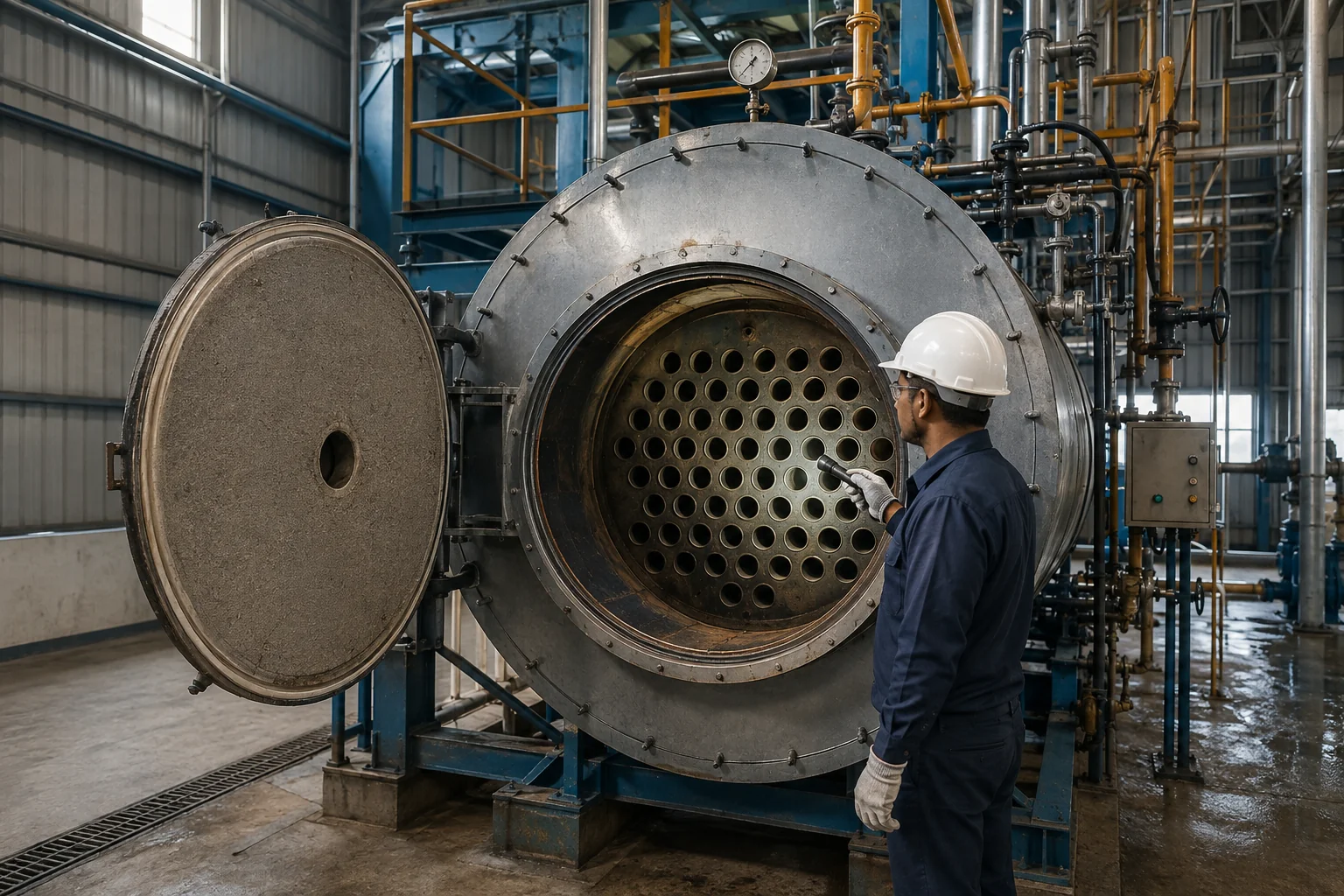
An annual shutdown becomes expensive when the team opens the boiler and only then discovers that the right gaskets, tubes or valve-service arrangements are missing. A maintenance checklist should bring those decisions forward. For a textile factory in Gazipur or a food plant in Chattogram, the objective is a prepared work scope and a documented return to service.
Use the framework below to organise work, then set the actual intervals against your boiler manufacturer's instructions, service history and inspection requirements. It is not a universal operating procedure. The UK HSE's industrial boiler management guidance emphasises competent management, suitable maintenance and clear responsibilities; it is useful engineering background, not Bangladesh law.
Start with a named owner and an equipment register
List the pressure vessel, burner or furnace, feed pumps, water-treatment plant, controls, steam header and condensate equipment. Identify which contractor or employee owns each task. Record the boiler serial number and connect every report to that identity.
Separate routine operating observations from functional tests and shutdown work. Reading a gauge does not prove that a safety trip will operate. A completed maintenance visit also does not replace a statutory examination. Keep the required inspection programme alongside the maintenance plan so neither is assumed to cover the other.
Build the operating record
| Planning interval | Work to include in the site schedule | Evidence to retain |
|---|---|---|
| Each operating shift | Record pressure, water level, feedwater condition, alarms and abnormal noise or leakage | Signed shift log with exceptions |
| Daily or as the approved water programme requires | Test the specified water parameters and review treatment operation | Results, limits, chemical adjustments and responsible person |
| Weekly planning review | Review recurring alarms, pump behaviour, fuel consumption and outstanding defects | Updated defect register |
| Monthly or scheduled service visit | Review burner performance, instruments, accessible insulation and auxiliary equipment | Measurements and service report |
| Quarterly planning review | Reassess shutdown scope, recurring faults and critical spare stock | Approved work list and purchase requests |
| Annual or otherwise scheduled shutdown | Carry out agreed internal examination, cleaning, repairs and tests | Inspection findings, repair records and release documents |
These are headings for your schedule, not permission to postpone an urgent defect until the next visit. Apply the site's escalation procedure when a safety function fails or readings move outside approved limits.
Make the daily log useful
A log full of identical ticks gives the next shift little help. Capture actual readings where meaningful, together with the operating load. A higher stack temperature at similar load can justify investigation; a single reading without context cannot tell the engineer why it changed.
For water treatment, include the parameters specified for your plant, the sampling point and the accepted range. Softener outlet water, feedwater and boiler water are different samples. Mixing them in one column hides the problem you are trying to detect. Our feedwater treatment guide explains why the treatment train needs its own checks.
Record alarms with the time, operator response and work-order number. Repeatedly resetting the same alarm without finding its cause should remain an open defect, not a completed task.
Prepare the shutdown before production stops
Four to six weeks is a useful planning allowance for a straightforward local shutdown, but imported parts and specialist work may need longer. Confirm access, contractor availability, lifting needs and the inspection appointment before fixing the production schedule.
The pre-shutdown pack should include:
- Equipment identification and the current defect list.
- The agreed examination and repair scope.
- Required parts, materials and gasket specifications.
- Isolation, cooling, access and work-permit arrangements.
- Contractor responsibilities and inspection hold points.
- Acceptance criteria, test records and restart authority.
Do not plan confined-space entry as an ordinary cleaning task. Vessel access, hot work and electrical work need the applicable site controls and competent personnel. Avoid prescribing hydraulic test pressures or safety-valve adjustments from a generic checklist; those belong in approved equipment-specific procedures.
Let condition decide the cleaning scope
Inspect accessible waterside and fireside surfaces and record the locations of deposits, leakage, corrosion or refractory damage. Photographs should identify the component and position so a later inspection can compare the same area.
Choose cleaning methods from the deposit type, construction and inspection findings. Chemical descaling is not an automatic quarterly requirement. If treatment history suggests recurring scale, correct the water problem as part of the work. Otherwise cleaning restores performance only temporarily.
Where pressure-part repairs or thickness assessments are needed, retain the measurement map and the engineer's acceptance basis. A single thickness reading or a successful pressure test does not describe the condition of the whole vessel.
Close the job before restart
The handover should confirm that tools and temporary fittings are removed, guards and insulation are restored, instruments are connected, and defects have an agreed disposition. Record the required control and protective-function tests using approved procedures. Complete applicable inspection steps before operation resumes.
During controlled restart, follow the manufacturer's sequence and observe the system at the agreed operating conditions. Keep an initial performance baseline: steam output where measured, pressure stability, fuel use, water readings and unresolved observations.
Use a simple record format throughout the year: date, equipment ID, task or reading, acceptance limit, finding, action owner, due date and close-out evidence. It can live in your existing spreadsheet or maintenance system; consistency matters more than software.
For a planned shutdown in Savar, Narayanganj or another industrial zone, send our engineering desk your boiler details and available dates. We can scope boiler repair and maintenance around the inspection findings and production window.
Common questions
Is this a fixed maintenance schedule for every boiler?
No. It is a planning framework. The manufacturer, competent engineer, operating conditions and applicable inspection requirements determine the actual tasks and intervals.
Should every boiler be chemically descaled each quarter?
No. Cleaning should follow inspection findings and water-treatment history. Unnecessary or poorly controlled chemical cleaning can damage equipment.
Who should approve return to service?
The responsible competent personnel should close defects, confirm required examinations and tests, and sign the site handover before restart.
More from the blog
- Maintenance planningBoiler AMC or breakdown calls: compare the full costCompare a boiler annual maintenance contract with on-demand repairs using downtime assumptions, service scope, response commitments and spare-parts exclusions.
- Boiler selectionFire-tube vs water-tube boilers for textile dyeingCompare boiler construction, load response, maintenance access and purchase specifications before selecting steam equipment for a Bangladesh textile mill.