
Waste-to-fuel compliance
Burning jhut (fabric waste) as boiler fuel, compliantly
Cutting-room jhut is free fuel, but a standard grate and stack were not designed for melting synthetic fibre. Here is what changes in the furnace and flue gas train to burn fabric waste without clogging tubes or failing a DoE emission test.
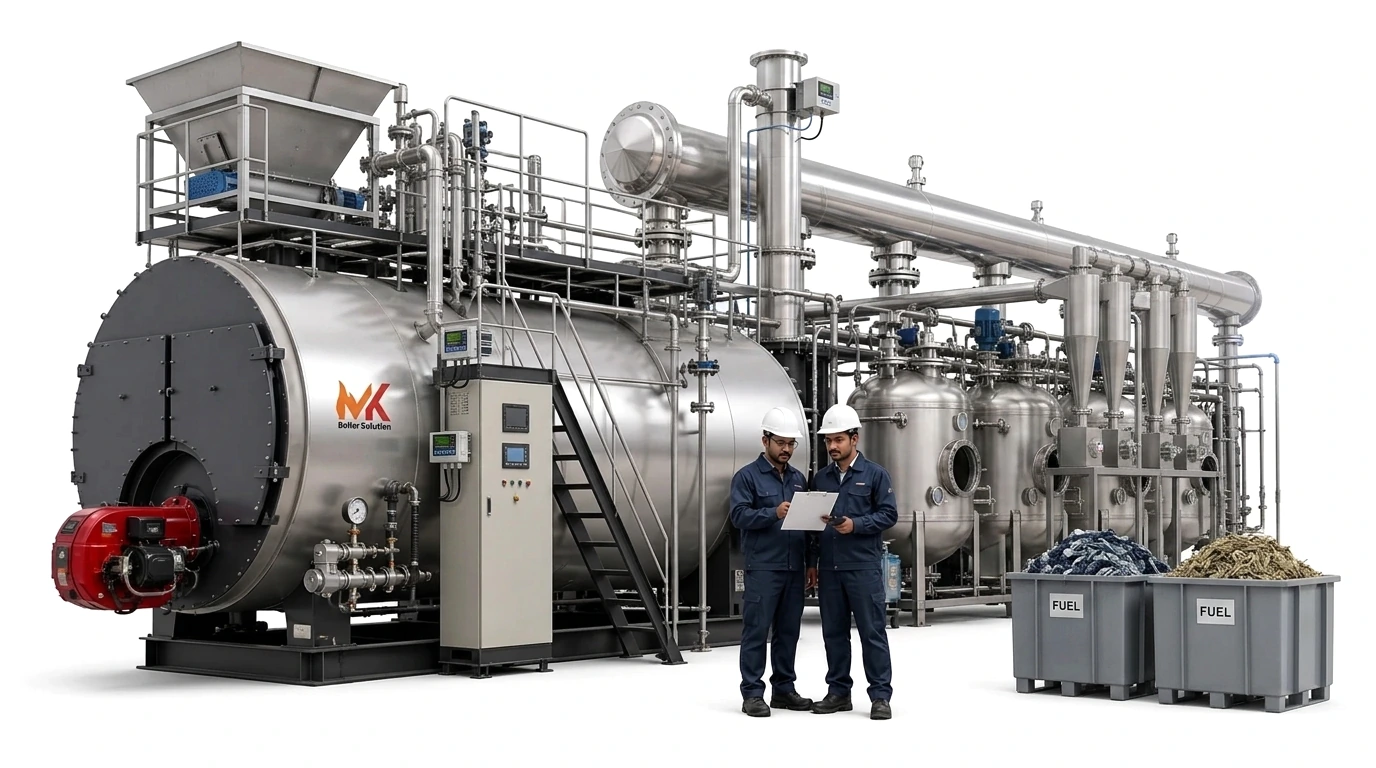
Every garment factory with a cutting room generates jhut - fabric offcuts that currently either get sold to a waste dealer for a token price or paid for by weight to be hauled off site. Burned in a properly modified boiler, that same material is fuel a factory is already generating for free. The economics are straightforward. The combustion engineering is not, and getting it wrong produces clogged tubes, a failed emission test, or both.
The economics of a fuel you already own
Jhut has two costs today that a compliant combustion retrofit reverses at once: the cost of disposal (or the foregone revenue of selling it below value to a dealer), and the cost of the gas or biomass fuel it could be displacing. A cutting room producing several hundred kilograms of offcuts a day is not going to fuel a large boiler on its own, but as a supplementary fuel blended with rice husk or briquette, it lowers the primary fuel bill by whatever fraction of steam demand the jhut volume covers - at close to zero marginal fuel cost, since the material exists on site regardless.
The number worth measuring before committing capex is simple: weigh a week's cutting-room waste, convert it to an approximate steam contribution at a conservative NCV, and compare that to current disposal and haulage costs plus the fuel it would displace.
A worked figure from a mid-sized knitwear unit in Ashulia: a cutting room producing roughly 800 kg of mixed cotton-poly offcuts a day, at a conservative NCV of 3,500 kcal/kg once moisture and synthetic content are allowed for, contributes close to 3.5 tons of steam a day when blended alongside the primary biomass fuel - against a factory averaging 30 tons of steam a day, that is a meaningful dent in primary fuel volume at close to zero marginal cost, on top of removing what the factory was previously paying a waste dealer to haul away.
Why jhut is not a drop-in biomass fuel
Cutting-room waste is not clean cellulose. Most RMG output blends cotton with polyester, spandex and other synthetics, and that blend is exactly what causes the three failure modes that show up first in an unmodified boiler:
- Synthetic fibre melts before it burns. Polyester and similar synthetics pass through a melting phase before combusting. On a standard biomass grate designed for husk or wood, melted fibre drips through grate openings, re-solidifies, and fuses ash and unburnt material into a mass that blocks air flow through the grate.
- Smoke tube clogging. Partially combusted synthetic fibre carries more particulate and tar-like residue into the tube bank than husk or wood ash does. Left unaddressed, this builds a fouling layer inside fire tubes faster than a normal soot-blowing schedule is designed to handle, cutting heat transfer and raising stack temperature.
- Toxic flue gas components. Incomplete combustion of synthetic fibres can release compounds - including hydrogen chloride from PVC-based trims and elevated particulate loading - that a standard husk-fired boiler's flue gas train was never sized to handle, and that a DoE stack test will flag if filtration is inadequate.
Engineering requirements for compliant jhut combustion
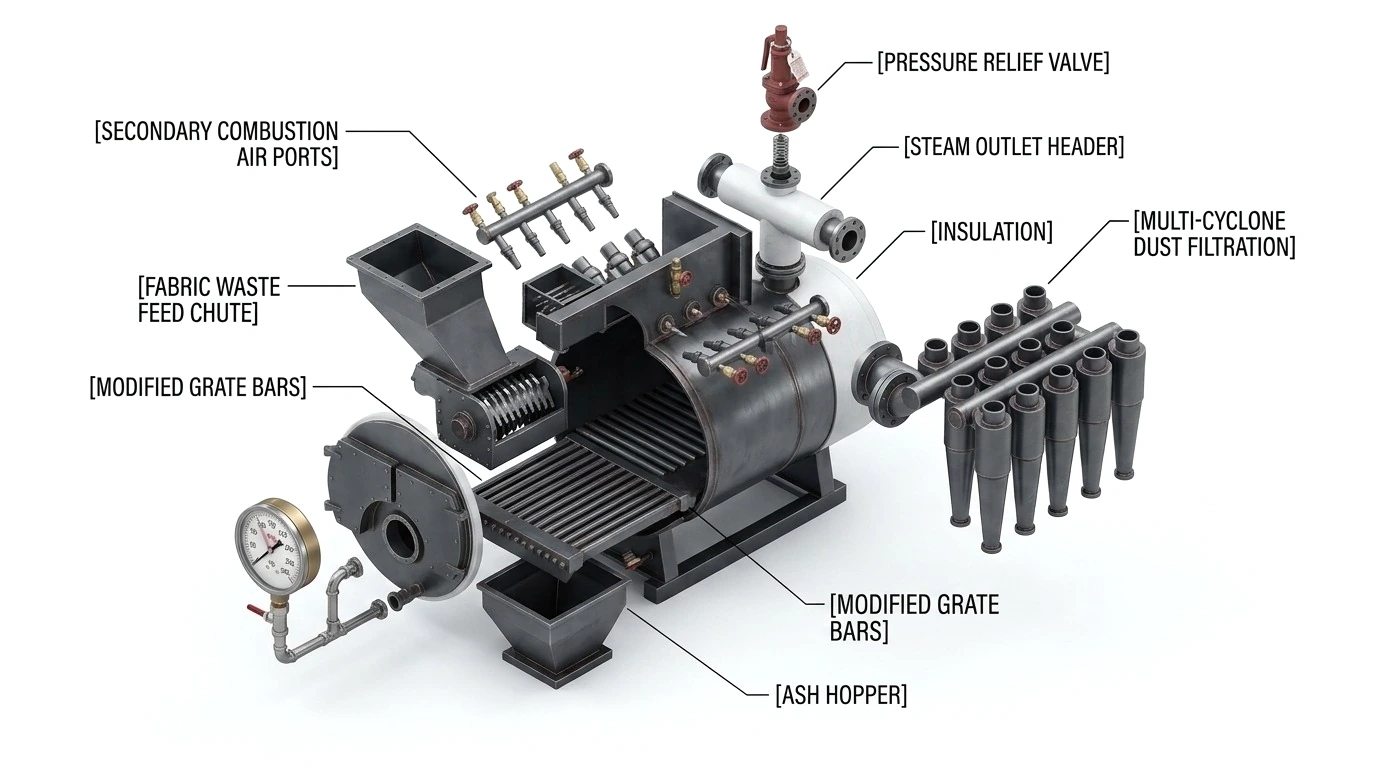
| Requirement | What it addresses | Why it matters |
|---|---|---|
| Secondary combustion air | Completes combustion of synthetic fibre volatiles above the primary grate | Reduces unburnt hydrocarbons and particulate reaching the tube bank |
| Modified grate bars | Wider, self-clearing grate geometry that sheds melted-and-resolidified residue instead of trapping it | Prevents the grate blockage that causes the most frequent unplanned shutdowns |
| Pre-shredding or sizing of feed | Uniform, sized jhut feed rather than loose offcuts of random size | Improves combustion consistency and feeder reliability |
| Multi-cyclone dust filtration | Strips particulate from flue gas before the stack | Standard single-cyclone units are usually undersized for jhut's higher particulate loading |
| Stack emission monitoring | Confirms SPM, and where relevant HCl, stays within DoE limits | Required for the DoE clearance a jhut-fired boiler needs to operate legally |
Sorting matters as much as equipment. A cutting room that keeps PVC-trim and heavily coated scraps out of the fuel stream removes a large share of the compliance risk before the flue gas train has to deal with it at all - the cheapest control on this list is the sorting bin at the cutting table.
What a compliant retrofit actually changes
None of the requirements above touch the boiler's pressure vessel or its OCIoB registration. The retrofit is entirely on the combustion and flue gas side: a modified grate section, secondary air ports and blower, a feed system sized for jhut rather than husk, and filtration upgraded to match the higher particulate loading. Factories already running a biomass combustor for rice husk or briquette are usually closer to jhut-ready than a gas-only boiler, since the grate and fuel-feed infrastructure already exists and needs modification rather than a full build.
Book a technical consultation
Burning jhut without the right grate, secondary air and filtration is how a factory turns a free fuel into a failed stack test and a blocked tube bank. Our combustion and compliance team assesses your cutting-room waste volume, your existing boiler's readiness for solid-fuel combustion, and the emission-control equipment needed to burn jhut within DoE limits - book a technical consultation before committing to the retrofit.
Common questions
Can jhut (fabric cutting waste) be burned in a standard biomass boiler?
Not without modification. A standard biomass grate is built for rice husk or wood, not for fabric that includes polyester and other synthetics. Burning jhut as delivered - unsorted and without secondary combustion air - causes melted fibre to clog grate openings and smoke tubes, and produces flue gas that will not pass a DoE stack test.
Is burning jhut in a boiler legal in Bangladesh?
Yes, with the correct equipment and DoE clearance. The Department of Environment permits solid waste fuels including textile waste where the boiler demonstrates compliant emissions - typically requiring secondary combustion air, a modified grate and multi-cyclone or equivalent dust filtration, verified by a stack emission test.
How much can a garment factory save by burning its own cutting waste?
Jhut from an in-house cutting room is effectively a zero-cost fuel once the retrofit is in place - factories that previously paid to have jhut hauled away, and separately paid for gas or biomass, capture both sides of that swing. The exact saving depends on cutting-room waste volume against total steam demand.
More from the blog
- MaintenanceAn annual boiler maintenance checklist for factory managersPlan daily records, periodic servicing and the annual shutdown with clear responsibilities, inspection evidence and a controlled return to service.
- Maintenance planningBoiler AMC or breakdown calls: compare the full costCompare a boiler annual maintenance contract with on-demand repairs using downtime assumptions, service scope, response commitments and spare-parts exclusions.